
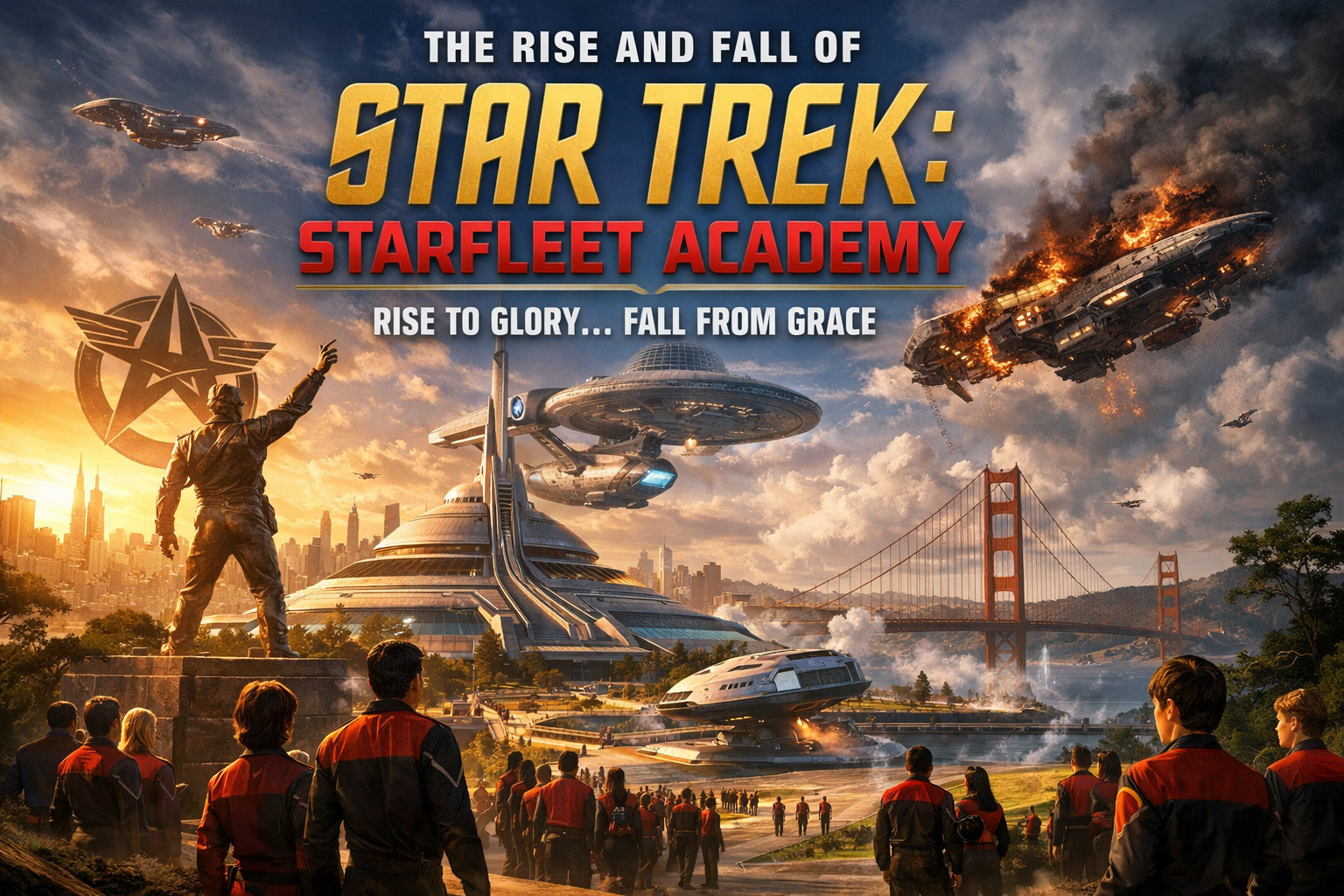
The Rise and Fall of Star Trek: Starfleet Academy!
By: R.A. Rayne
Starfleet Academy ventured to boldly go where no one has gone before! From the very beginning, Gene Roddenberry and the Star Trek franchise have pushed the boundaries of human imagination and challenged us to explore new frontiers, both in what we see cinematically and in how we live socially. Star Trek: Starfleet Academy carries on this tradition, which may have led to its demise.
Star Trek: Starfleet Academy is a young adult (YA) space adventure that blends the academic life with the high-stakes action aboard a Starfleet vessel. Set in the 32nd century on stardate 853724.6 (125 years after the Burn), before jumping forward to align with the events of Star Trek: Discovery Season 5.
The show follows a diverse group of young cadets as they learn to navigate the demanding life of Starfleet, form friendships, face rivalries, and experience first loves while training as officers under Chancellor Nahla Ake (Holly Hunter). Nahla is a Lanthanite/Human hybrid. Lanthanites were first introduced in the first episode of the second season of Star Trek: Strange New Worlds, featuring Chief Engineer Pelia (Carol Kane). Lanthanites are an extremely long-lived humanoid species, described as living “almost forever,” which has given Ake a distinctive style of command. From her bare feet to her habit of leaning back with her feet up on the armrest of her captain’s chair, Nahla Ake’s laid-back posture and attire are not in line with the standard of a Starfleet captain we are used to in a Star Trek series.
Nahla Ake is a former Starfleet captain who resigned from the United Federation of Planets after choosing the law over her conscience and ruling to separate a mother from her young son. Fifteen years later, Nahla is recruited to serve as Chancellor of the newly recommissioned Starfleet Academy and is reunited with Caleb Mir (played by Sandro Rosta), the human she had separated from his mother. Now, 15 years later, Chancellor Ake forces Mir to choose between attending the newly formed Starfleet Academy, or facing a prison sentence.
Joining Mir are fellow cadets Jay-Den Kraag (Karim Diané), a passive Klingon who prefers science to battle; SAM “Series Acclimation Mil” (Kerrice Brooks), a hologram created solely to reintegrate her photonic species with organic lifeforms; Darem Reymi (George Hawkins), a Khionian, a semi-aquatic species capable of transforming his hairless gray scales and black eyes to look identical to Humans; and Genesis Lythe (Bella Shepard), a humanoid Dar-Sha and the daughter of a decorated Starfleet admiral, determined to make her own name.
Rounding out the cast are Zoë Steiner (Tarima Sadal: firstborn daughter of Betazed President Emerin Sadal, sister of Ocam Sadal, and member of the First House of Betazed); Robert Picardo (the Doctor: a 900-year-old holographic teacher originally from the series Star Trek: Voyager (1995–2001)); Tig Notaro (Jett Reno: Starfleet Academy Instructor and USS Discovery alum); Gina Yashere (Lura Thok: the part-Klingon, part-Jem’Hadar first officer of the Athena and the cadet master at Starfleet Academy); Brit Marling (voice of the USS Athena’s computer); Oded Fehr (Fleet Admiral Charles Vance); and Stephen Colbert (the voice of Starfleet Academy’s Digital Dean of Students).
When Starfleet returned to Sol 3 (Earth), Starfleet Academy returned to its original location in San Francisco, a center of hope where cadets, including the rebellious street kid Caleb Mir, learn to work together. But Academy life isn’t all about learning the Kobayashi Maru or a Kolvoord Starburst. When a new, mysterious threat to the Federation tied to Caleb Mir and Nahla Ake’s past emerges, the stakes rise. Nus Braka (Paul Giamatti), a “Klingarite” (a hybrid of Klingon and Tellarite) who leads the Venari Ral, is a villainous pirate and smuggler determined to destroy the fragile Federation’s new alliances. He has his sights not only on destroying Starfleet but also on Nahla and her cadets. The series explores the tension between honoring the wisdom of the old generation and forging a new path to correct the mistakes of the past.
Starfleet Academy, like most Star Trek shows before it, challenges social conventions while acknowledging the world we live in. It is written to appeal to a younger generation. It tackles social dynamics, emotional situations, and the vernacular of its Gen Z audience, trying to do so subtly, like its predecessors. Like the original series, Starfleet Academy attempts to hide its social consciousness in a futuristic world. Unfortunately for the show, the polarized state of our society and social media has lashed out at the very reasons that make the show appealing to the audience it was designed for.
While many question the show’s writing, it is hard to dispute the brilliance of Starfleet Academy’s Season 1, Episode 8, “The Life of the Stars,” which features the cadets studying Thornton Wilder’s play Our Town. Starfleet Discovery alum Lieutenant Tilly (Mary Wiseman) returns to teach the class, using the play as a form of theatrical therapy to help the cadets process the trauma of a training mission that ended in their capture and the life-or-death decisions most Starfleet officers would struggle to make. The episode explores themes of mortality and the appreciation of life while letting the cadets come to terms with who they are becoming, without heavy-handedly guiding them to a conclusion.
Shortly after filming for Season Two wrapped and Season One ended, Paramount+ announced that Starfleet Academy would be canceled. No reason was given for the cancellation. Many believe it is due to online backlash over the show’s diversity or to low viewership. Despite having more than 25K signatories, Paramount+ has given no indication that the show will be renewed. There may be more to the cancellation than a ‘lack of fan support.’
After Skydance Media purchased Paramount, there has been talk that they may be planning a Star Trek reboot. With Star Trek: Strange New Worlds ending after its fifth season and the rumored spinoff series Star Trek: Year One, in which Paul Wesley takes command of the USS Enterprise as Captain James T. Kirk, now in doubt, this may very well be the real reason for Star Trek: Starfleet Academy’s demise.
While Starfleet Academy was not for everyone, I know many longtime Trekkies who did not like the show, but I enjoyed the series. It was the first Star Trek series I could sit down with my wife and our eighteen-year-old daughter to watch, and she enjoyed it as well. That was the beauty of the series.


It’s interesting to see how much the Academy tries to recapture that original optimistic spirit of the early Trek shows. The balance between training and adventure seems tricky, though.
Appreciate the effort you put into this.